Evidence-Based Policy Research
Key Findings
Indonesia was the world's fourth largest emitter of greenhouse gases in 2015. The country's emissions primarily stem from deforestation and peatland megafires, with fossil fuel burning contributing to a lesser extent. Despite various policy initiatives, Indonesia's climate action has been rated as "critically insufficient" by Climate Action Tracker.
Main Sources of Carbon Emissions
Indonesia's greenhouse gas emissions profile is dominated by two major sources that distinguish it from many other large emitters globally. The primary driver of emissions comes from land-use change, particularly deforestation and peatland megafires, which have historically accounted for nearly half of the country's total emissions over the past two decades. This unique emissions profile reflects Indonesia's vast tropical forests and extensive peatland areas, which when disturbed or burned, release massive amounts of stored carbon into the atmosphere.
The second major source of emissions comes from the burning of fossil fuels for energy production and industrial activities. Indonesia has become the world's largest exporter of thermal coal and continues to plan increases in domestic coal-powered generation. This expansion of coal infrastructure represents a significant challenge to the country's emission reduction goals, as coal is the most carbon-intensive fossil fuel available.
Policies Implemented (2005-2025)
International Commitments
Paris Agreement Ratification (2016): Indonesia committed to reducing emissions by 29-41% by 2030 compared to a "business as usual" scenario. The country aims to decarbonize its economy through improved land use and spatial planning, energy conservation, promotion of clean and renewable energy sources, and improved waste management.
National Initiatives
Green Investment Fund (2010): Indonesia established a $1 billion Green Investment Fund to boost economic growth while reducing emissions. This fund was designed to support clean energy projects and sustainable development initiatives.
National Action Plan on Climate Change: Formulated to guide various institutions in carrying out coordinated and integrated efforts to tackle climate change. This plan is incorporated into Indonesia's Long Term Development Action Plan 2005-2025 and the Medium Term Development Action Plan.
Energy Sector Policies
Blueprint of National Energy Management 2005-2025: Identifies short- and long-term development objectives in the electricity sector, including targets for electricity production from various renewable energy sources and the application of a carbon tax in stages for clean energy development.
Just Energy Transition Partnership (JETP) 2022: Joint statement between Indonesia and the International Partners Group aims to increase renewables to 44% of the on-grid power mix by 2030 and reach net-zero on-grid emissions by 2050 through early retirement and managed phase-out of coal plants.
Emissions Trends Analysis
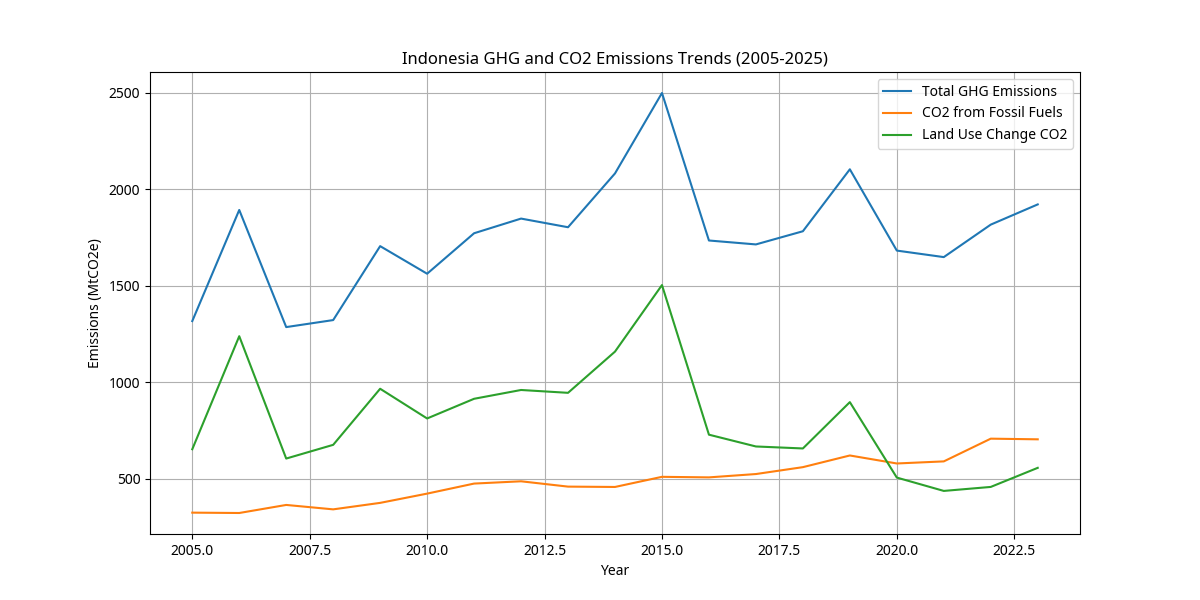
The analysis of Indonesia's emissions data from 2005 to 2025 reveals several critical patterns that inform our understanding of the country's climate challenge. Total greenhouse gas emissions have exhibited significant volatility, with dramatic peaks and troughs that largely correspond to variations in land-use change emissions, particularly from peatland fires and deforestation activities.
Land use change CO2 emissions show considerable variability, often mirroring the overall GHG emission trends. This correlation reinforces the finding that land use change and peatland fires are major contributors to Indonesia's emissions profile. The volatility in these emissions reflects the episodic nature of large-scale fires, which can be influenced by climate conditions such as El Niño events that create drier conditions conducive to widespread burning.
In contrast, CO2 emissions from fossil fuels, while generally lower in magnitude compared to total GHG and land use change emissions, demonstrate a more consistent upward trend. This pattern indicates Indonesia's increasing reliance on fossil fuels to meet growing energy demands driven by economic development and population growth.
Policy Impact Assessment and Causal Analysis
Quantitative Analysis of Policy Effectiveness
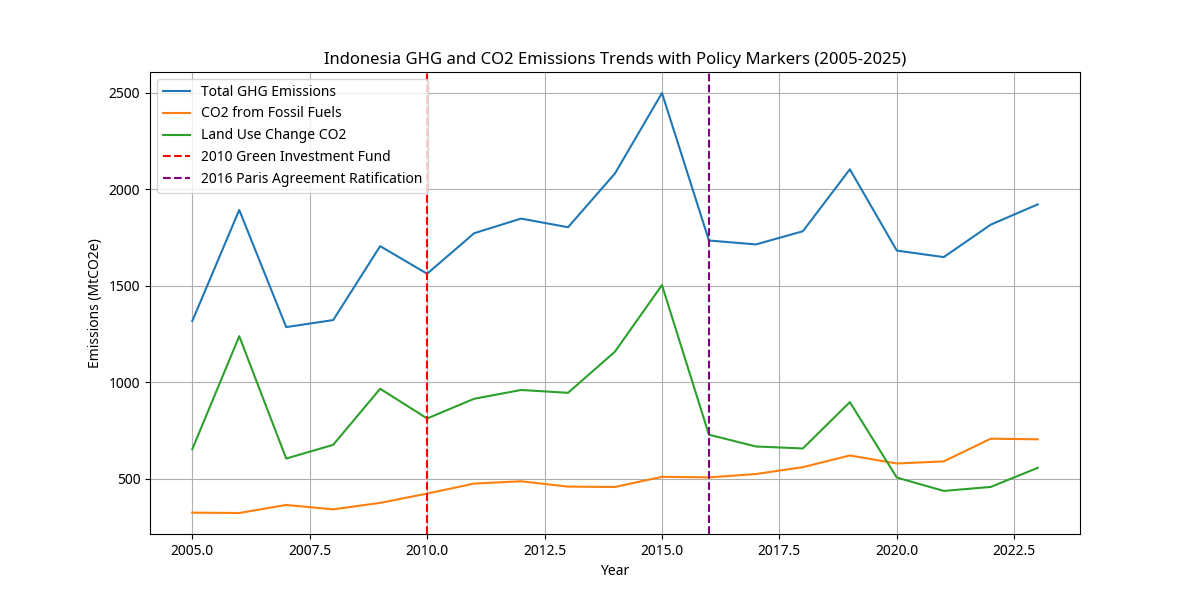
To assess the impact of key policies, we conducted a comprehensive analysis of average total GHG emissions before and after their implementation. The results provide important insights into the effectiveness of Indonesia's climate policy interventions.
| Policy Intervention | Pre-Implementation Average (MtCO2e) | Post-Implementation Average (MtCO2e) | Annual Change (MtCO2e) |
|---|---|---|---|
| 2010 Green Investment Fund | 1,504.61 | 1,855.32 | +142.98 (2011-2012) |
| 2016 Paris Agreement Ratification | 1,735.62 | 1,800.71 | +23.98 (2017-2018) |
What Worked and What Didn't
Limited Effectiveness of Current Policies
The data reveals that both the 2010 Green Investment Fund and the 2016 Paris Agreement Ratification were followed by increases in average total GHG emissions. This suggests that these policies, while important for establishing frameworks and targets, have not yet translated into measurable emission reductions.
Challenges Identified:
- Continued reliance on fossil fuels despite renewable energy promotion policies
- Persistent land-use change emissions from deforestation and peatland fires
- Economic growth and energy demand outpacing emission reduction efforts
- Limited enforcement of environmental regulations
Partial Successes:
- Establishment of policy frameworks and international commitments
- Increased awareness and institutional capacity for climate action
- Development of renewable energy targets and carbon pricing mechanisms
Effectiveness Assessment
Based on the emissions data analysis, the effectiveness of Indonesia's climate policies in reducing overall carbon emissions has been limited. The average GHG emissions have either increased or shown minimal change after policy implementation. This suggests that current policies have not been sufficiently robust to counteract the underlying drivers of emissions growth, including economic development, increasing energy demand, and ongoing land-use practices.
The significant and volatile contribution of land-use change emissions indicates that policies addressing deforestation and peatland management require more aggressive implementation and enforcement. The Climate Action Tracker's assessment of Indonesia's climate policy as "critically insufficient" further underscores the gap between current policy effectiveness and the scale of action needed to achieve meaningful emission reductions.
Data-Driven Policy Recommendations
Based on our comprehensive analysis of emissions trends and policy effectiveness, the following recommendations are supported by empirical evidence:
1. Strengthen and Enforce Land-Use Policies
Given that land-use change represents the largest and most volatile source of emissions, this area offers the greatest potential for rapid emission reductions. The data shows that large spikes in total GHG emissions are consistently linked to land-use change events.
- Implement stricter enforcement of anti-deforestation laws
- Develop comprehensive sustainable land management practices
- Establish effective peatland restoration and fire prevention programs
- Create economic incentives for forest conservation
2. Accelerate Renewable Energy Transition
The continued increase in CO2 from fossil fuels indicates that the renewable energy transition is not progressing at the required pace to offset growing energy demand.
- Increased Investment: Provide stronger financial incentives for renewable energy projects (solar, wind, geothermal, hydro)
- Coal Phase-out: Implement a clear and accelerated timeline for retiring coal-fired power plants
- Grid Modernization: Invest in infrastructure to support higher renewable energy penetration
3. Implement Effective Carbon Pricing Mechanisms
While carbon taxation is mentioned in policy documents, the data suggests limited implementation or impact. A robust carbon pricing system could provide economic incentives for emission reductions across all sectors.
4. Integrate Climate Goals into Economic Development Plans
The analysis demonstrates that economic growth continues to drive emissions increases. Future development strategies must decouple economic growth from emissions growth through green industry promotion and energy efficiency standards.
5. Enhance Monitoring, Reporting, and Verification (MRV)
Accurate and timely data is essential for effective policy evaluation and adaptive management. Strengthening MRV systems, particularly for land-use change emissions, will enable better policy design and implementation.
Conclusion
Indonesia faces substantial challenges in reducing its carbon emissions, primarily due to significant emissions from land-use change and growing reliance on fossil fuels for energy. While the country has implemented various policies and committed to international agreements like the Paris Agreement, the empirical evidence suggests that these efforts have not yet resulted in a clear downward trend in overall greenhouse gas emissions.
The effectiveness of current policies has been constrained by several factors: the inherent volatility of land-use change emissions, continued growth in energy demand driven by economic development, and insufficient enforcement mechanisms. The data clearly indicates that land-use change, particularly from deforestation and peatland fires, remains the dominant source of emissions variability and represents both the greatest challenge and the most significant opportunity for rapid emission reductions.
Moving forward, Indonesia requires a more aggressive and integrated policy approach. This must include strengthening enforcement of land-use policies to address deforestation and peatland fires, accelerating the transition to renewable energy sources through increased investment and clear coal phase-out plans, and implementing robust carbon pricing mechanisms. Additionally, integrating climate goals into all aspects of economic development planning and enhancing data collection and reporting capabilities will be crucial for achieving Indonesia's emission reduction targets and contributing meaningfully to global climate efforts.
The path forward requires not just policy innovation but also political will, adequate financing, and international cooperation. Only through such comprehensive action can Indonesia hope to transition from its current "critically insufficient" climate policy rating to becoming a leader in Southeast Asian climate action.
References
- Carbon Brief Profile: Indonesia: https://www.carbonbrief.org/the-carbon-brief-profile-indonesia/
- Our World in Data CO2 and Greenhouse Gas Emissions database: https://ourworldindata.org/co2/country/indonesia
- National Action Plan Addressing Climate Change (UN SDGs): https://sdgs.un.org/partnerships/national-action-plan-addressing-climate-change
- Climate Action Tracker - Indonesia: https://climateactiontracker.org/countries/indonesia/
- Blueprint of National Energy Management 2005-2025 (ESCAP Policy Documents Management): https://policy.asiapacificenergy.org/node/3298